

Wrist Swelling, Pain, and a Palpable Lump (Ganglion Cyst) Treatment


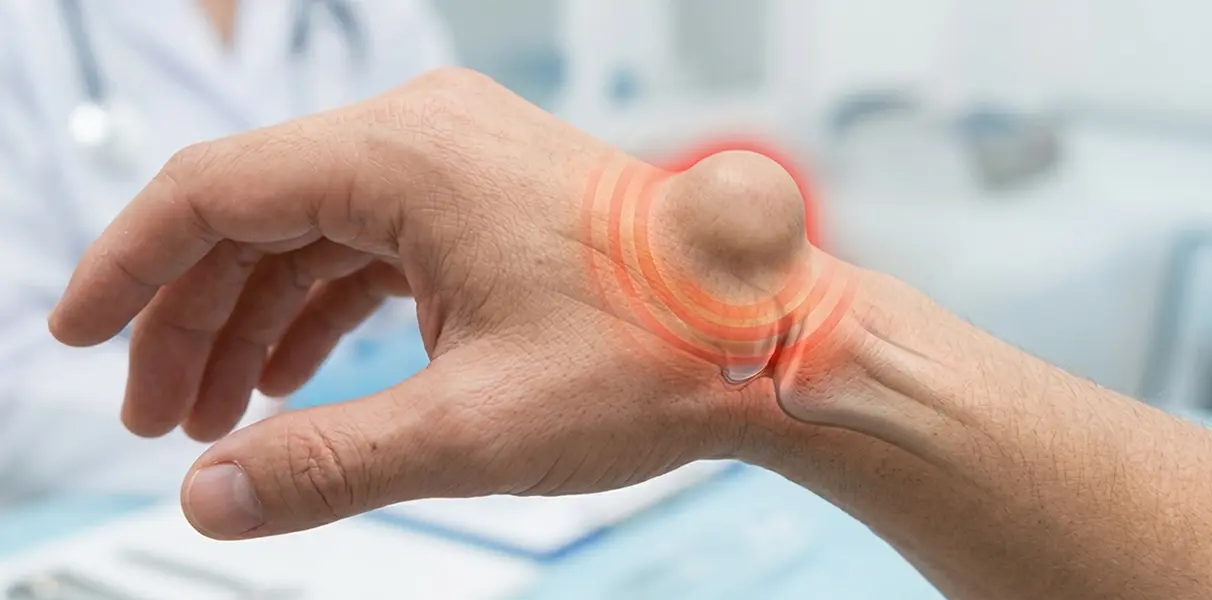
Have you noticed a swelling that has developed on your wrist over time? This lump, which sometimes grows and sometimes shrinks, feels tender when you press on it, or causes pain during movement, is most often a benign growth called a ganglion cyst. Ganglion cysts are among the most common soft tissue masses of the hand and wrist.
Although they carry no risk of becoming cancerous, depending on where they are they can cause pain, limited movement, and difficulty with daily activities. Computer users, people who use their wrists intensively, and athletes in particular often visit orthopedic clinics with these complaints.
In this article, we take a detailed look at why ganglion cysts form, their symptoms, how they are diagnosed, and current treatment options.
What Is a Ganglion Cyst?
A ganglion cyst is a benign cyst filled with jelly-like fluid that arises from a joint capsule or tendon sheath.
The most common locations are:
- The back of the wrist
- The palm side of the wrist
- The base of the fingers
- The finger joints
Cysts can feel soft or firm, and their size can change over time.
Why Does a Ganglion Cyst Form?
The exact cause of ganglion cysts is not fully known. However, weakness in the tissues around a joint or tendon is thought to play a role.
Risk factors include:
- Heavy use of the wrist
- Repetitive movements
- Sports injuries
- Wrist injuries
- Previous ligament injuries
- Some joint diseases
Although ganglion cysts can occur at any age, they most often appear in people between 20 and 40.
What Are the Symptoms of a Ganglion Cyst?
Some ganglion cysts are noticed without causing any symptoms. But as they grow, they can press on surrounding tissues.
The most common symptoms are:
- A palpable lump on the wrist
- Pain during movement
- A feeling of fullness in the wrist
- Discomfort when gripping
- Stiffness in the wrist
- Reduced range of motion
- Numbness or tingling in some patients
The severity of symptoms can vary depending on the size and location of the cyst.
Does a Ganglion Cyst Cause Pain?
Not every ganglion cyst causes pain. Small cysts can go unnoticed for a long time.
However, pain may occur when:
- The cyst presses on nerves
- The wrist is used frequently
- The cyst restricts joint movement
- There is strain during sports or heavy work
Pain may become more noticeable especially when using a computer, writing, or carrying weight.
Can a Ganglion Cyst Turn Into Cancer?
A ganglion cyst is a benign growth and does not turn into cancer.
However, not every palpable lump should be assumed to be a ganglion cyst.
Any lump on the wrist that:
- Grows quickly in size,
- Causes severe pain,
- Feels hard and immobile,
- Developed after an injury
requires an expert evaluation.
Can a Ganglion Cyst Go Away on Its Own?
Some small ganglion cysts may shrink or disappear completely over time.
However, treatment may need to be planned if the cyst:
- Causes symptoms,
- Keeps growing,
- Restricts movement,
- Comes back
How Is It Diagnosed?
Diagnosis begins with a detailed medical history and a physical examination.
Your doctor will:
- Assess the location of the lump.
- Examine its size.
- Check the range of motion.
- Assess whether there is pain.
When needed, the following imaging methods may be used:
- Ultrasound
- Magnetic Resonance Imaging (MRI)
- X-ray
Although an X-ray does not show the cyst directly, it can help evaluate the bone and joint structure.
How Is a Ganglion Cyst Treated?
Treatment is planned according to the size of the cyst and the patient’s symptoms.
Monitoring
Small ganglion cysts that cause no pain and do not affect daily life can be monitored at regular intervals.
Activity Modification
Reducing movements that strain the wrist can help relieve symptoms.
Wrist Splint
In some patients, wearing a splint for a short time can help reduce pain.
Aspiration (Draining the Cyst)
In suitable patients, the fluid inside the cyst can be drained with a fine needle.
However, with this method there is a chance that the cyst will form again.
Surgical Treatment
Surgery may be considered in the following situations:
- Persistent pain
- A recurring ganglion cyst
- Nerve compression
- Limited movement
- Large cysts
- Symptoms that significantly affect daily life
During surgery, the cyst and the capsule tissue it is connected to are removed in an effort to reduce the risk of recurrence.
What Should You Pay Attention to at Home?
The following recommendations may help support treatment:
- Do not try to burst or crush the cyst.
- Avoid movements that cause pain.
- Do not strain your wrist unnecessarily.
- Set up an ergonomic workspace.
- Do not use other treatment methods without medical advice.
Folk methods such as crushing the cyst with a hard object can cause serious tissue damage and are strongly discouraged.
When Should You See a Doctor?
In the following situations, it is recommended that you see a specialist experienced in orthopedics and traumatology or hand surgery:
- A palpable lump on the wrist
- The cyst gradually getting bigger
- Pain during movement
- Numbness or tingling
- Reduced grip strength
- Limited movement
- Symptoms that persist for a long time
Early evaluation allows an accurate diagnosis and appropriate treatment planning.
Does a Ganglion Cyst Come Back?
In some patients, ganglion cysts can form again after treatment.
The risk of recurrence can vary depending on:
- The size of the cyst,
- Its location,
- The treatment method used
The likelihood of recurrence is usually lower after surgery, but it cannot be said to be eliminated completely.
Conclusion
A ganglion cyst is one of the most common causes of swelling, pain, and palpable lumps on the wrist. Although most ganglion cysts are benign, they can cause pain, limited movement, and nerve compression. That is why lumps that grow, cause pain, or affect your daily life should not be ignored.
If you have noticed a lump on your wrist, or if it is accompanied by pain, numbness, or loss of strength, it is important to see an orthopedics and traumatology specialist for an accurate diagnosis and appropriate treatment planning. Early evaluation helps avoid unnecessary worry and ensures that any necessary treatment is planned in time.

Specialist Opinion
A ganglion cyst is one of the most common causes of swelling, pain, and palpable lumps on the wrist. Although most ganglion cysts are benign, they can cause pain, limited movement, and nerve compression. That is why lumps that grow, cause pain, or affect your daily life should not be ignored.
If you have noticed a lump on your wrist, or if it is accompanied by pain, numbness, or loss of strength, it is important to see an orthopedics and traumatology specialist for an accurate diagnosis and appropriate treatment planning. Early evaluation helps avoid unnecessary worry and ensures that any necessary treatment is planned in time.
Contact us to have your symptoms assessed and to learn about treatment options that may be right for you. Get in touch .
Frequently Asked Questions
A swelling on the wrist that develops over time, sometimes grows and sometimes shrinks, and feels tender when pressed is most often a ganglion cyst. A ganglion cyst is a benign cyst filled with jelly-like fluid that arises from a joint capsule or tendon sheath. However, not every lump is a ganglion cyst; an examination is needed for a definitive diagnosis.
No, a ganglion cyst is a benign growth and does not turn into cancer. However, an expert evaluation is needed if a wrist lump grows quickly, causes severe pain, feels hard and immobile, or appeared after an injury.
Some small ganglion cysts may shrink or disappear completely over time. However, treatment may need to be planned if the cyst causes symptoms, keeps growing, restricts movement, or comes back.
No. Folk methods such as crushing the cyst with a hard object can cause serious tissue damage and are strongly discouraged. Do not try to burst the cyst yourself, and do not use other treatment methods without medical advice.
Small cysts that cause no symptoms can be monitored. Options include activity modification, a short period of splinting, draining the cyst with a fine needle (aspiration), or surgery. The cyst may come back after aspiration; with surgery, the cyst and its connected capsule tissue are removed, so recurrence is usually less likely, though it cannot be ruled out completely.
 WhatsApp
 Facebook
 Twitter
 Linkedin







 +90 505 398 34 34
 doctoryavuzarikan@gmail.com
 Book Appointment / Contact